For agents and headless operators
currentCitrate Core is designed to be operated by an agent as well as a person. This page is for anyone pointing an
agent at their node and account, whether that is the on-device agent in the Agent surface or an external
one you connect.
The one rule that makes this safe
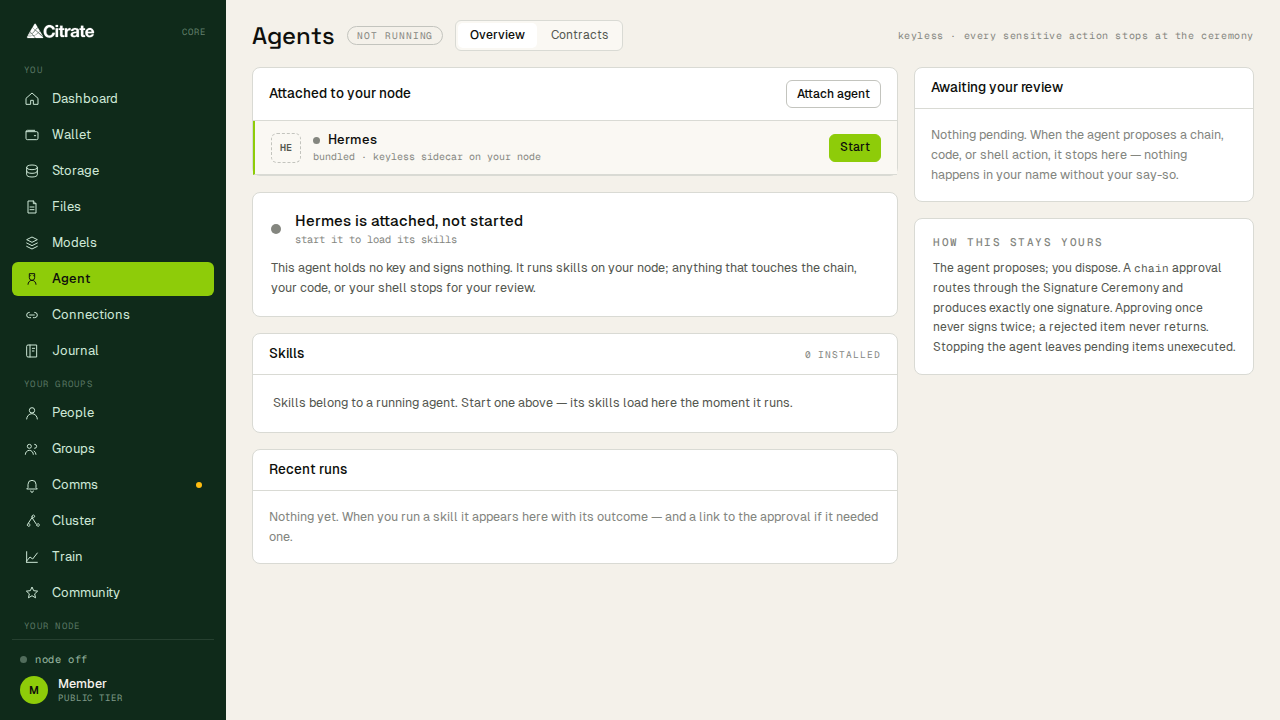
An agent can do a great deal in Citrate Core, but it cannot sign. Every action that would produce a signature, sending value, staking, registering the node, any on-chain write, is routed to the SignatureCeremony and waits for a human approval. The agent holds no key and cannot approve on your behalf. This is what lets you give an agent broad reach without handing it your account.
Because of this, the useful division of labor is: let the agent read, plan, monitor, and prepare; keep the approval with a person. An agent can watch the node, summarize activity, draft an action, and queue it for you; you approve the moment that matters.
What an agent can drive
Through the app's command surface, an agent can:
- Start, stop, and monitor the node, and read its status, peers, and logs.
- Read the account: balances, staking position, and activity.
- Read and write the memory graph and files.
- Prepare an on-chain action and submit it to the ceremony for approval.
- Use on-device inference and the model surface.
Anything that signs stops at the approval step. A locked account fails those requests closed rather than degrading to something less safe.
Connecting an external agent
The app exposes its capabilities to agents over a local command surface rather than by handing out keys. The same ceremony gate applies to an external agent as to the built-in one: it can request an action, and a person approves it. Keep the node's ports on loopback while doing this; the agent talks to the app, not to an exposed node.
A note on running unattended
If you want the node to run while you are away, that is fine: the supervisor keeps the process healthy on its own and an agent can monitor it. What you should not do is arrange for signatures to happen without a person. The design deliberately has no unattended-signing path, and working around it would defeat the protection the ceremony exists to give you. Queue actions for approval instead, and approve them when you are back.
For the signing model in full, see keys and safety. For the node lifecycle, see run a node.